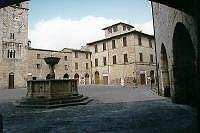
Piazza Silvestri, the centre of medieval and modern Bevagna, is without any doubt one the most medieval squares of Umbria, of irregular shape, almost casual, with the most significant buildings facing the square.
The
Palazzo dei Consoli dates back to 1270 : it rises on top of a double-naved cross-vaulted open hall with Gothic arches; the front shows two rows of twin-windows and a large stair on the side leads to the great hall at the first floor. In 1866, inside has been built the beautiful Teatro Francesco Torti, restored in occasion of the centenary.
The fountain in front of the palazzo, though seeming to be of the 14th century, is instead a well realised imitation of the year 1889, matching perfectly with the square and its buildings, such as the
Chiesa di S. Silvestro, built in 1195 by Master Binellus, according to the inscription on the right of the portal.
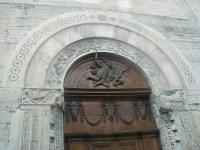
The front is unfinished (or maybe collapsed): it should have resembled to the one of the church in front, S. Michele. On the right corner you will note the remains of the collapsed bell-tower. On top of the embedded portal with vine and animal bas-relief decorations opens a triple-window, while two twin-windows mark the location of the aisles. The nave has a barrel vault and the side aisles have half-barrel vaults. The first column on the right has been replaced by a pillar meant to support the bell tower. After three spans rises the high presbytery (of two spans). Underneath lies the three-aisled cross-vaulted crypt with a single apse, in line with the apse of the presbytery. The supporting columns are quite unusual: They are all tapered and bear capitals with a double row of very simplified acanthus leaves.
On the other side of the square rises the
Chiesa di S. Michele Arcangelo, also built by Master Binellus, with the aid of Master Rodolfus, and as well of the end of the 12th century. Its front gives the idea of how the front of S. Silvestro looked like (or should have looked like), with the bell-tower inserted on its right side. Contrary to S. Silvestro, the collegiate church of S. Michele has been transformed in 1741 in Baroque forms. The actual look of the front is the result of a partly arbitrary restoration of 1953/54. The large circular window over the portal replaces the former Baroque window of different shape and lower location. The upper part of the bell tower has been erected in a later period then the rest. The middle portal deserves a special attention: rich medieval bas-reliefs have been sculptured in Roman remains and the first row is decorated by Cosmatesque mosaics. During the Baroque transformation, the capitals of the columns in the interior were mutilated and replaced by stucco-works and the nave covered by vaults. The restoration of the ‘50ies tried to restore the former medieval style but nor the beamed ceiling nor the lateral windows of the nave are ascertained. It is infact more likely that the nave was originally barrel-vaulted. The nave counts seven spans and the superelevated presbytery three; although the latter has three aisles it ends in a single apse. The crypt underneath repeats the three-aisle structure but its nave is ulteriorly divided thus forming 12 cross-vault units. The church conserves a “Crucified” by Providoni with wooden shapes representing Our Lady, Mary Magdalene and St. John. In a room next to the presbytery stands the the silver statue of St. Vincent by Peter Ramoser (1785). In the Cappella della Madonna del Carmine (third chapel on the right), added in 1463 and renewed in 1607, there are frescoes by Andrea Camassei (1624-28).
Also interesting, in
Via S. Margherita, is the
Chiesa di S. Margherita, originally of the 13th century but later modified in Baroque forms: you will find a beautiful altar-piece by Andrea Camassei, a fresco by Fantino (1592) and a suggestive “Scala Santa” (Holy Stairs) by Providoni.
Very characteristic are the fortified
Porta dei Molini, with the tower and the guard-room on top of the gate decorated with corbels and the near mill complex with the wash-house on the torrent.