





Umbria OnLine
  
Eco-Skin Care
Eco-Skin Care
Direttamente dal Costruttore
Ospitalità di lusso dal 1922
Vendita immobili senza intermediari
Perugia Perugia Perugia
Gubbio

Excursions Outside Gubbio


After visiting the town centre, a series of other important monuments can be visited along the three main roads that lead away from Gubbio.

Chiesa di Santa Maria della Vittoria The first road, towards Perugia, leads past the 17th century church of Madonna del Prato. Its finely crafted facade conceals a Greek cross interior layout with an elliptical cupola decorated with the magnificent fresco of 'Glory of Paradise' (1674-78) by Francesco Allegrini, who also painted the altar piece depicting the 'Martyrdom of St Stephen' on the left hand altar


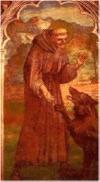
San Francesco e il Lupo Not far off, beyond the Camignano river in Via della Piaggiola, stands the church of Santa Maria della Piaggiola, erected in the first half of the 17th century to honour a 'Madonna with Child' by Ottaviano Nelli in fact painted for the previously existing 14th century church. The 'Pietà' (~1444) by Domenico di Cecco also adorned the previous structure. Although the exterior is unfinished, the interior of the church contains surprisingly rich and finely crafted stucco decorations.

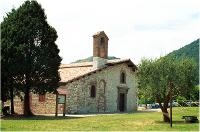
Via della Piaggiola continues into Via Frate Lupo, where there is the church of Santa Maria della Vittoria. Legend has it that when St Francis stayed in the convent here he met a wolf in the nearby wood that he managed to tame only with his words.
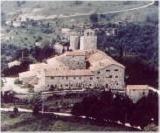
Abbazia di S. Verecondo o Vallingegno Back on the main road to Perugia, shortly before the village of Scritto a short deviation leads to the abbey of San Verecondo or Vallingegno, rebuilt in the 13th century over a previously existing building. The small apsed crypt dates from the 11th century and contains a late-Imperial Roman ark that contains the remains of the martyr St Verecondo. A short distance down from the abbey stands the castle of Vallingegno, a powerful forrtress that is dominated by a high keep and which made up a defence line of the left hand bank of the river Chiascio along with the other castles of Petroia, Biscina and Coccorano.

The second road out of Gubbio leads towards Umbertide. The convent of San Secondo stands directly outside the city walls and was once the headquarters of the administration that controlled church lands in the Ravenna and Gubbio areas. During the period from 568 to 772, after the fall of the Roman Empire, the 'Byzantine Corridor' of church lands was the only remaining safe passage from Christian Rome to Byzantium. Previously a building had been erected here on the remains of a Roman temple. The last in a long series of alterations was carried out in the 15th century. The fake trilobate arches on the exterior of the apse are 18th century, while the 14th century interior is Gothic in style. With its re-used Roman columns, the Chiostro dei Canonici is also interesting. The Pamphili chapel in the nearby cemetary also belongs to the monastery and is entirely frescoed by Giovanni Beda di Benedetto (1457) with 'Stories of St Sebastian'. The surface of the altar bears the date 1134, even though the decorative motifs are 7th-8th century.

At Madonna del Ponte, 2 km from Gubbio, stands a little Romanesque church built around 1200, an early example of ogival arch construction whose interior was modified in the 18th century.
At Mocaiana a short detour to Loreto leads to Pieve di San Giovanni Battista. Built in the 12th century, a simple facade is broken only by an acute Gothic doorway. The crypt, which is accessible from the exterior, is particularly interesting.

Back on the road to Umbertide, at Val d‘Assino on the crossroads for Pietralunga, stands the castle of Carbonara, one of the best preserved castles in the surrounding area, built to initial designs in the 12th century. At Camporeggiano there is the abbey of San Bartolomeo, founded in 1067. The three-nave interior is subdivided by broad arches that rest on square pilasters. The flight of steps that leads to the raised presbytery is not original, while the apse is probably later than the rest of the building. Beneath the presbytery, the crypt is composed of three narrow apses. The columns that support the ceiling have been taken from earlier buildings and are surmounted by unusual 11th century inverted pyramic capitols.

Lastly, the third road, leads to Gualdo Tadino. Aftter the village of Padule stands the d’Alfiolo castle, built by the d’Alfiolo counts in the 11th century and successively transformed into a Benedictine abbey at the end of the 12th century. This later use of the building has lent it its alternative name of “Badia”. A fine 1224 plant motif decorative frieze with animal and human figures has been incorporated into the facade of the building. Originally it decorated the portal of the church but was walled up when the direction of the building was turned. In 1539 the bishop of Gubbio, the future Pope Marcellus II, adopted the building as his residence. He paved the church with the fine terracotta flooring we see today, and added the tree shaped well head in the cloister in 1536. Marcellus' successors completed the work he had started by transforming the abbey into a late-Renaissance style residence. Currently the structure is used as a country house bed & breakfast.
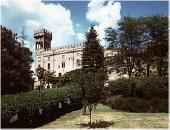
Castello Torre dei Calzolari Further along the same road, an ancient feudal castle with the small village of Torre Calzolari stands on a hillock not far off. The Guelph crenellations, based on Palazzo dei Consoli, and the loggia are 19th century Romantic additions to the original structure. Today the castle is a hotel. The last castle in the line of defences along the Gubbio valley stands to the south-east of the city, near Branca. It is the castle of Colmollaro, where the poet Dante is said to have stayed guest of the Raffaelli counts. Traces of the original grandiose feudal structure of the building, with another tower, are still visible today.

© Copyright 2001-2012 by UmbriaOnline.com

Top

Perugia Perugia
CITIES OF UMBRIA
Acquasparta
Allerona
Alviano
Amelia
Arrone
Assisi
Attigliano
Avigliano Umbro
Baschi
Bastia Umbra
Bettona
Bevagna
Calvi dell'Umbria
Campello sul Clitunno
Cannara
Cascia
Castel Giorgio
Castel Ritaldi
Castel Viscardo
Castiglione del Lago
Cerreto di Spoleto
Citerna
Citta della Pieve
Citta di Castello
Collazzone
Corciano
Costacciaro
Deruta
Fabro
Ferentillo
Ficulle
Foligno
Fossato di Vico
Fratta Todina
Giano dell'Umbria
Giove
Gualdo Cattaneo
Gualdo Tadino
Guardea
Gubbio
Lisciano Niccone
Lugnano in Teverina
Magione
Marsciano
Massa Martana
Monte Castello di Vibio
Monte Santa Maria Tiberina
Montecastrilli
Montecchio
Montefalco
Montefranco
Montegabbione
Monteleone di Spoleto
Monteleone d'Orvieto
Montone
Narni
Nocera Umbra
Norcia
Orvieto
Otricoli
Paciano
Panicale
Parrano
Passignano sul Trasimeno
Penna in Teverina
PERUGIA
Piegaro
Pietralunga
Poggiodomo
Polino
Porano
Preci
San Gemini
San Giustino
San Venanzo
Sant Anatolia di Narco
Scheggia e Pascelupo
Scheggino
Sellano
Sigillo
Spello
Spoleto
Stroncone
TERNI
Todi
Torgiano
Trevi
Tuoro sul Trasimeno
Umbertide
Valfabbrica
Vallo di Nera
Valtopina
PING

Gubbio News

Gubbio
Appointments & Events
Wedding in Gubbio
Restaurants
Pizzerie
Hotels
Country Houses
Holiday Farms
Gubbio: Embroidery laboratories
Umbrian Textiles and Embroidery Tour - Tele Umbre
Umbrian Textiles and Embroidery Tour - Intaglio Embroidery in Gubbio
Antiques Market in Gubbio
Gubbio Under the Roman Empire
Gubbio in the Middle Ages
Through the Streets of the Old Town Centre
Excursions Outside Gubbio
The Basilica of Sant'Ubaldo and the Ceri Race
Palazzo Ducale
Events
Crossbow Palio
 Regional News by Category

MUSIC
EXHIBITIONS
COURSES
COMPETITIONS & PRIZES
FOLKLORE
EVENTS
DANCE & BALLET
MEETING & CONFERENCES
CONGRESS
KIDS
Typical Products FAIRS
THEATRE
SPORT EVENTS
LEISURE
LIFESTYLE
WHERE TO DINNER
NIGHTLIFE
CURIOSITY
VIDEO
BOOKS


EUGUBINO AREA 

Province: Perugia
Area: Eugubino (Costacciaro; Fossato di Vico; Gualdo Tadino; Gubbio; Scheggia e Pascelupo; Sigillo; Valfabbrica;)
comprensorio Eugubino

INFORMATION 

FIGURES
Province: Perugia
Area: Eugubino
Altitude: 500 m s.l.m.
Surface: 525.08 kmq
Population: 32564 (01.01.07; Istat)
Inhabitants name: Eugubini
ZIP 06024
Tel. area code: 075

Localities: Bellugello, Belvedere, Biscina, Branca, Burano, Caicanbiucci, Camporeggiano, Carbonesca, Carpiano, Casa Morcia, Case Corso, Colpalombo, Corraduccio, Loreto Basso, Madonna della Cima, Mocaiana, Montanaldo, Monteleto, Montelviano, Padule, Pisciano, Ponte d’Assi, S. Bartolomeo, S. Benedetto Vecchio, S. Marco, S. Martino in Colle, S. Cristina, S. M. di Colonnata, Scritto, Semonte, Serra Brunamonti, Torre Calzolari, Via Macchia

Comune di Gubbio
Via XX Settembre, 1 Tel. 07592371 Fax 0759275378

Famous Personalities: S. Ubaldo (1080-1160); Oderisi da Gubbio (miniaturista, XIII sec.); Matteo di Giovannello, detto il Gattapone (architetto, XIV sec.); Guido Palmerucci (pittore, XIV sec.); Martino, Ottaviano e Tommaso Nelli (pittori, sec. XIV-XV); Bosone Raffaelli (scrittore, sec. XIII—XIV); Giorgio Andreoli detto Mastro Giorgio (ceramista, sec. XV-XVI); famiglia Maffei (intagliatori, sec. XVI); Giuseppe Mazzatinti (letterato, 1855-1905).


SCG Business Consulting S.a.s. di Giacomelli E. & C. - Internet Advertising Division - © 2001-2012 All Rights Reserved - P.IVA 01675690562